AppX Deployment Service (AppXSVC) provides infrastructure support for deploying Store applications. This service is started on demand and if disabled Store applications will not be deployed to the system, and may not function properly.
This tutorial contains several solutions to resolve the high usage issues on the hard disk or on the CPU, caused by the Windows Store WASPPX process on Windows 8 or 8.1 & Windows 10 based systems.How to resolve WSAPPX (WSService) high CPU or HDD usage issues.Solution 1. Scan your computer for viruses.Some viruses or malicious programs can cause your system's CPU, Memory or Hard disk to work at high levels. So, before you continue to troubleshoot high usage problems, use this to check and remove viruses or/and malicious programs that may be running on your computer.Solution 2. Disable Windows Store Service. (Windows 8 & 8.1)Windows Store (WSService) service is essential for all applications downloaded from Windows Store.
So proceed to disable it only if you never use apps from Windows Store.Keep in mind that Windows Store application cannot be disabled in Windows 10 Pro and Home editions. It can only disabled in Windows Server 2012, Windows 8, 8.1, Windows 10 Enterprise or Windows RT editions.In you own a Windows 10 PRO or a Windows 10 Home PC and you don't want the Windows Store, then you can read the following tutorial for the available solutions.If you own a Windows 8 & Windows 8.1 computer then you can disable the Windows Store app by following the instructions below. How to Turn Off Windows Store in Windows 8 & Windows 8.1:1. Simultaneously press the Windows key + R keys to open the ' Run' command box.2.
In run command box, type: regedit and press Enter. IMPORTANT: Before you continue, first take a backup of your registry. To do that:1. From the main menu, go to File & select Export.2. Specify a destination location (e.g. Your Desktop), give a filename to the exported registry file (e.g. ' RegistryUntouched'), select at Export range: All and press Save.4.
After you have backed up your registry, navigate to the following location at the left pane:. HKEYLOCALMACHINESOFTWAREPoliciesMicrosoftWindowsStoreNote: If 'WindowsStore' key does not exist then right-click at Microsoft key and select New Key and name it ' WindowsStore' (without quotes).5. Right-click on an empty space at the right pane and select New DWORD Value.6. Give at the new value the name RemoveWindowsStore. Double click at the newly created RemoveWindowsStore value and at the value data box type 1.8. Close Registry Editor and restart your computer.– From now on, whenever you try to launch the Windows Store, the following message will be displayed on your screen: ' Windows Store isn't available on this PC. Contact your system administrator for more information'.Solution 3.
Increase the virtual memory (Paging file).1. Right click on Computer icon (Name) and select Properties.2. Click Change Settings.3. At Advanced tab select Settings at Performance section. At Performance options, click the Advanced tab and then select Change at Virtual memory section.5.
Uncheck the 'Automatically manage paging file size for all drives' check box.6. Check the 'Custom size' radio button.7. Set the Initial size and Maximum size values to twice and half (2,5) of your RAM size in MB.
and then press the Set button.For example: If your RAM's size is 4GB (4096MB), then type the value 10240 (4096MB x 2,5 = 10240MB) in the Initial & Maximum size (MB) fields.8. Click OK three (3) times to exit.9. Restart your computer. Disable 'Superfetch' & 'Windows Search' services.' Superfetch' service cashes data from an open application to RAM, so if you close and re-open the same application, this application is loaded faster and in that way 'Superfetch' improves the system's performance.
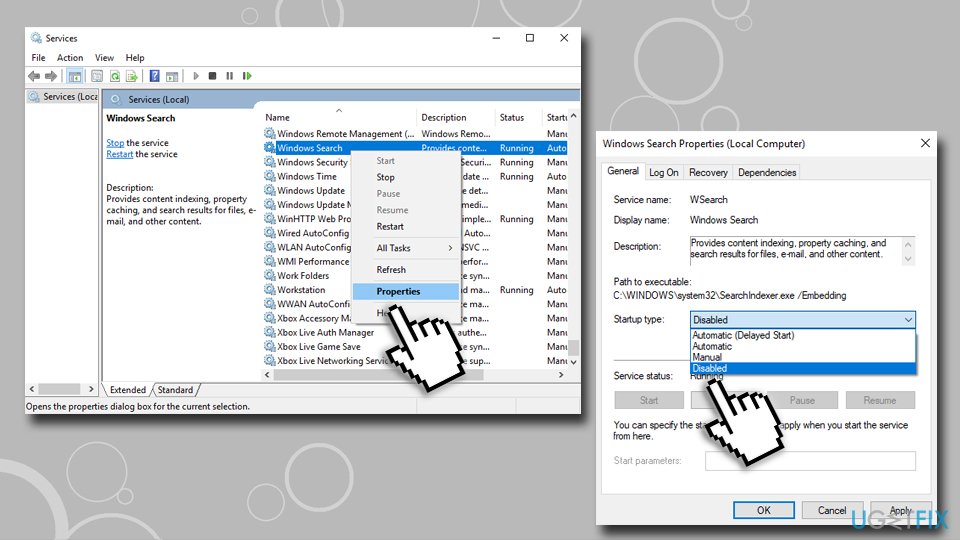
But, the 'Superfetch' service (also known as 'Prefetch'), many times is causing high usage on your hard disk or on your CPU, so try to disable it to eliminate the high usage on the CPU or hard disk.1. Simultaneously press the Windows key + R keys to open the ' Run' command box.2.
In run command box, type: services.msc and press Enter.3. Right click at Superfetch service and select Properties.4. Set the Startup type to Disabled.5. Press OK to close SuperFetch properties window.6. Restart your computer.7. If after the restart, the high usage behavior still exists then perform the same procedure but this time disable the Windows Search service.Solution 5. Run System Maintenance.Run the System Maintenance troubleshooter to automatically fix system's problems.1.
Right click at Windows start button and select Control Panel.2. Set the View by to: Small icons.3. Open Troubleshooting.4. Click on View all.3. Double click at System Maintenance.4. Press Next and then follow the onscreen prompts to run the System Maintenance troubleshooter.Other solutions to resolve CPU, HDD or Memory high usage issues. Rebuild Index.
Open 'Indexing Options' in control panel. At Indexing Options click Modify. Uncheck the Offline Files and click OK.
Click Advanced. Click the Rebuild button and press OK to rebuild the Index.2.
Disable Defrag Task.1. At Cortana's search box type task scheduler.2. Open the 'Task Scheduler' desktop app.3.
At the left pane go to Task Scheduler Library Microsoft Windows Defrag.4. At the right pane select the Schedule Defrag task and click Disable.5. Restart your computer.3. Uninstall Antivirus. Open 'Programs & Features' in Control Panel and uninstall the antivirus program. Then restart your computer. After the restart, check if the high usage issue persists.
Then reinstall your antivirus program or install another antivirus on your computer.That's it! Let me know if this guide has helped you by leaving your comment about your experience. Please like and share this guide to help others.
Here is a solution that causes basically no data loss only requiring that you may need reinstall some windows store apps. The problem seems to be caused by the store license database being corrupt. But since you are not able to stop the Windows Store service you need to start in safe mode. Then rename the folder 'C:ProgramDataMicrosoftWindowsClipSvc' to 'C:ProgramDataMicrosoftWindowsClipSvcXXX'.
You can also remove it if you wish.Then restart in normal mode and all will be fixed! Windows store will work properly if it wasn't before most likely as well.
If you’re running Windows 10 and it seems to be unusually slow, this might explain why …
When I launched the most recent version of Windows 10 today I noticed high cpu load almost immediately. I opened the Windows Task Manager with the keyboard shortcut Ctrl-Shift-Esc, clicked on the more details link and found the Windows process wsappx to be the cause (Note: the process may display as wsappx (2) or wsappx (3) as well).
Cpu use would go as high as 30% and while it went down at times, it did go up almost immediately again in the same moment.
If you expand the selection, one, two or even three Windows services are listed: Windows Store Service (WSService), Client License Service (ClipSVC) and AppX Deployment Service (AppXSVC).
AppX Deployment Service (AppXSVC)
Provides infrastructure support for deploying Store applications. This service is started on demand and if disabled Store applications will not be deployed to the system, and may not function properly.
Client License Service (ClipSVC)Toshiba windows 7 recovery disk iso torrent.
Provides infrastructure support for the Microsoft Store. This service is started on demand and if disabled applications bought using Windows Store will not behave correctly.
Windows Store Service (WSService)
Provides infrastructure support for Windows Store. This service is started on demand and if disabled applications bought using Windows Store will not behave correctly.
Attempts to stop one of the services, for instance by right-clicking on it in the Task Manager or the stop button in the Services manager may throw an error message that the service can not be stopped.
INSTALLATION INSTRUCTIONS L'Expression 1.6 GPF One-Piece Toilet Model 97420 BOLT COVERS TANK COVER SEAT W/CHROME HINGES BOLT COVER KIT FILL VALVE ASSEMBLY FLUSH VALVE ASSEMBLY - NO LONGER AVAILABLE 0 0 83420 1 1 2 1 1 CAUTION: DO NOT OVERTIGHTEN NUTS OR BASE MAY BE DAMAGED! Adhere bolt covers to toilet. May 20- Porcher Cygnet Toilet Seat Installation Manual. If you are pursuing embodying the ebook Porcher cygnet toilet seat installation manual in pdf. May 20- So if wishing to pile Cygnet toilet seat installation manual pdf, in that. Apr 2 20Porcher cygnet toilet seat has Go down to your local. I will now take more care and read the instructions! Fixing Toilet pan screwed and siliconed to floor. Cistern bolted directly to pan. Page 1 of 3 Warranty: 7 years domestic / 1 year commercial. CYGNET C/C BTW T/SUITE (4.) S Trap 140 – 270 mm. (recommend 180mm) P Trap 190 mm. Fixed Back inlet, left hand side or bottom inlet, left or right hand side. (Refer to Illustration ) Finished ˜oor WMK. 3 - 7301445-100EN-SP-FR Rev. D PORCHER ONE-YEAR LIMITED WARRANTY If inspection of this Porcher plumbing product, within one year after its initial installation, confirms that it is defective in materials or workmanship, Porcher will repair or, at its. Porcher cygnet toilet manual.
Windows could not stop the […] service on Local Computer. The service did not return an error. This could be an internal Windows error or an internal service error. If the problem persists, contact your system administrator.
This is however not always the case and if you wait some time and try again, you may be able to stop all of the services from running eventually. This worked on our test system once the cpu load reached 0.
The main issue with this approach is however that they may start up at any time again, and the core reason for that is the following.
All three services provide no option to change the startup type when accessed on a local computer system. The only startup type that is available is manual while automatic and disabled are grayed out.
What happens if you disable Windows Store in the Local Group Policy?
One would assume that disabling Windows Store would have an effect on the wsappx process but that is not the case.
To disable Windows Store in Windows 10, do the following:
- Tap on the Windows-key, type gpedit.msc and hit enter.
- Navigate to Local Computer Policy > Computer Configuration > Administrative Templates > Windows Components > Store.
- Double-click on Turn off the Store application and switch the policy to enabled.
- Restart the computer.
You will notice that the process is still up and running after you have disabled the Store on the system.
What happens if you end the wsappx task instead?
The wsappx task can be terminated in Windows Task Manager. If you select it and then end task it is killed.
Since this does not affect startup types it may appear again at any time though which means that it is more of a temporary solution than something that works permanently.
Closing Words
Wsappx is a process that Microsoft introduced in Windows 8.1. While it is clear that it is Store related, it is unclear why the process was not stopped after the Store was disabled on the system.
For now, it appears as if there is no solution to resolve high cpu usage of the wsappx process in Windows.
As far as high cpu usage goes, it is unclear why it is driving cpu up by that much at times.
Tags: CPU, task manager, Windows 10, Windows Store, wsappx